
How Three Bored PayPal Employees Accidentally Built YouTube
The billion-dollar startup that began as a failed video dating app.

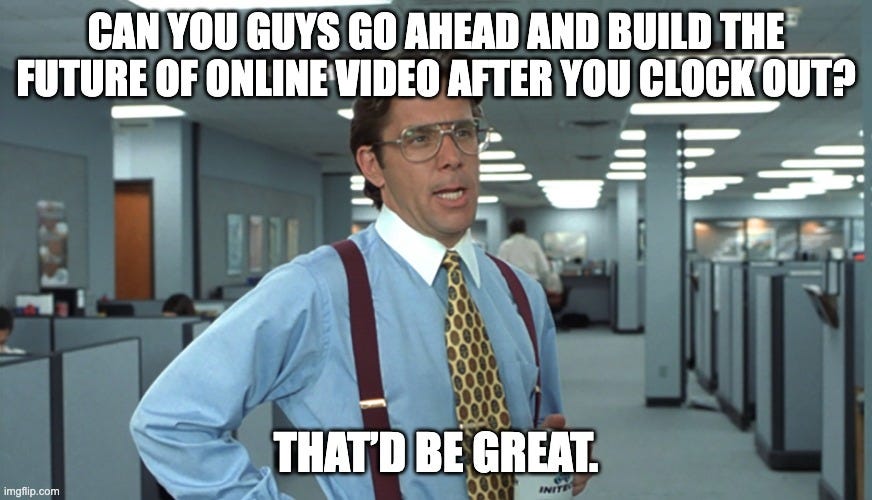
You ever sit in a corporate meeting thinking, “There has to be more to life than this”?
That was Steve Chen, Chad Hurley, and Jawed Karim in 2005. They were at PayPal when eBay bought the company, and overnight everything changed. The fast, scrappy culture disappeared. Meetings multiplied. Creativity faded. Their days became a loop of process and reporting.
So they left. They wanted to build something fun again. Something that felt alive. And, like many great startup stories, their next chapter started with simple coffee chats and open-ended brainstorming.
Prefer watching over reading?
👉 Here’s YouTube’s Go-To-Market Explained With Bananas — a fun, animated breakdown with marketing monkey.
The Original Idea: “Tinder, but with video.”
Their first idea was a video dating site. Users would upload short clips and others could match. It was clever but it completely flopped. No one wanted to upload a dating video in 2005.
Then the unexpected happened. A few early users uploaded completely unrelated videos: cats, vacation clips, funny moments with friends. The founders could have ignored them or forced the dating concept. Instead, they paid attention. And this tiny pattern changed everything.
The Pivot: Let people upload anything.
The moment they dropped the dating idea, the site felt different. People started watching and sharing. It was clear that users just wanted a frictionless way to upload and watch videos. Nothing like that existed at the time.
The Tech Breakthrough: Flash Player 8
The real breakthrough came when Flash Player 8 launched. It allowed YouTube to compress giant video files into smooth, instant playback inside any browser. Other video sites existed, but none made video feel effortless.
But video was expensive. Server bills exploded so fast that Steve Chen started paying them with his personal credit card until the bank shut it down. They needed capital fast.
The First Check: A Honeymoon Video Sells Sequoia
Most VCs dismissed them. “Who wants to watch random videos?” was the standard response. But a PayPal friend, Keith Rabois, believed in what they were seeing and made an intro to Sequoia.
During the meeting, a partner uploaded his honeymoon video to test the product. It played instantly. That single moment was the pitch. It demonstrated exactly why YouTube mattered. Sequoia wired 3.5 million dollars and gave YouTube the breathing room it needed to scale.
Competitors Attack and Backfire
Growth attracted attention, and not all of it was friendly. MySpace, the biggest platform in the world at the time, banned YouTube embeds to protect its own video ambitions. YouTube responded by telling users to complain directly. Thousands did. MySpace backed off.
Then NBC threatened lawsuits over Saturday Night Live clips. Instead of panicking, YouTube built a copyright scanning tool that eventually evolved into Content ID. NBC went from threatening legal action to forming a partnership.
These moments show something important. Great go to market execution is not just about distribution. It is about how you respond when powerful competitors show up.
Growth Explodes
Daily views jumped from 8 million to 35 million to 100 million. YouTube became early internet culture in motion. Dancing babies, viral memes, bedroom music videos, low-fi tutorials. It was chaotic, creative, and completely new.
But with massive growth came massive costs and rapidly increasing legal risk. That is when Google entered the picture.
The 1.65 Billion Dollar Deal That Changed the Internet
In 2006, Google acquired YouTube for 1.65 billion dollars. Google provided the infrastructure and systems that YouTube could not build alone. They launched:
Content ID to handle copyright
The Partner Program so creators could earn real money
The recommendation algorithm that kept viewers watching
These innovations transformed YouTube from a website into a global media ecosystem. Today, people watch 1 billion hours of YouTube every day. It is bigger than cable, bigger than Netflix, and the foundation of creator culture as we know it.
And it all happened because three bored PayPal employees noticed what users wanted before anyone else did.
Key Takeaways
1️⃣ Pivot early and often. User behavior is often a better compass than founder vision.
2️⃣ Reduce friction. When the experience becomes instant, adoption becomes natural.
3️⃣ Turn threats into advantages. Competitor pressure can be leverage if you respond creatively.
4️⃣ Leverage your network. One warm intro unlocked the funding that changed everything.
5️⃣ Empower creators. When creators grow, platforms grow.
TL;DR
YouTube did not begin with a perfect idea. It began with a failed one and founders who paid close attention to what users were actually doing. Some of the biggest ideas in tech start out looking small, strange, or unpolished. The magic happens when someone recognizes the signal inside the noise.
Enjoyed this read?
Share it with a friend who’s building something from scratch.
Until next time,
Henry Wang ✌️