
The Owl That Made Duolingo Unstoppable
How a bold social strategy turned a mascot into culture and made Duolingo one of the world’s most talked-about brands.

In September 2021, TikTok announced one billion users. In Duolingo’s Pittsburgh office, a new grad named Zaria walked past a giant green owl costume and thought:
If people are spending hours on TikTok, they’re not opening our app. So we should meet them there, on their terms.
That realization shaped Duolingo’s social strategy. Instead of treating TikTok like another marketing channel, they treated it like the main stage. Today the account is the largest brand presence on TikTok with 16.7M followers and 457M+ likes.
Here’s the 7-part playbook that made it happen and what you can borrow for your own GTM.
1. Attention Is the Real Competitor
Duolingo’s rivals weren’t Babbel or Rosetta Stone. The true enemy was distraction.
Every minute spent scrolling TikTok, Instagram, or YouTube was a minute not spent doing a Duolingo lesson.
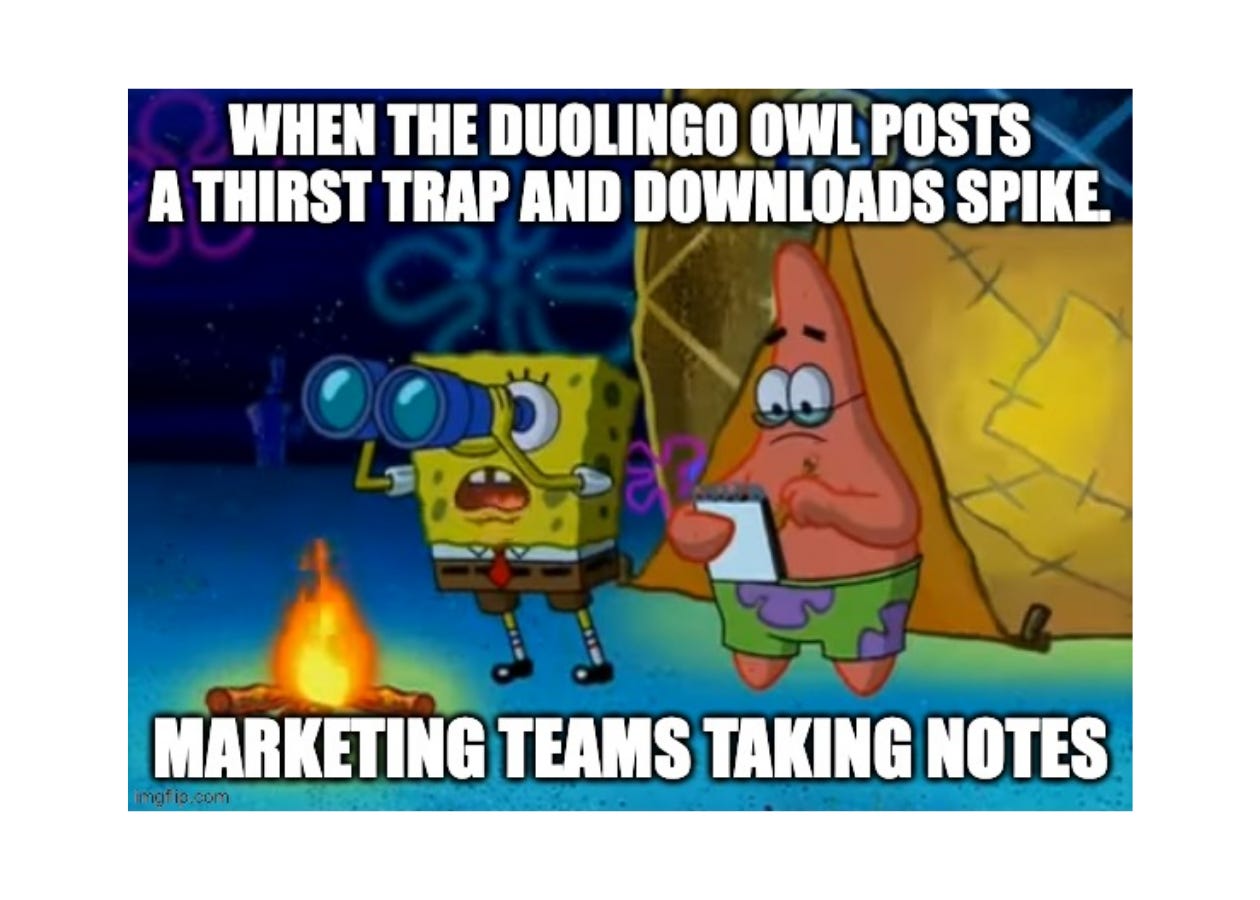
So the team made attention the north star: win minutes back. Success wasn’t measured by “beating other apps” but by intercepting culture. Viral posts reliably showed up in download spikes and survey responses like “I heard about you on TikTok.”
👉 Lesson: Start by defining your attention competitor. If users are on X, they’re not in you. Your job is to earn those minutes back.
2. Entertainment First, Product Second
Nobody opens TikTok hoping to practice conjugations. They’re there for humor, surprise, and distraction.
Duolingo leaned into that by leading with entertainment (the candy) and only then slipping in the product (the medicine) through captions, comments, or pinned replies.
Example: One recurring gag shows the Duolingo owl barging into people’s daily lives — sitting in on a date, lurking in an office meeting, or staring through a window — and refusing to leave until the user finishes their lesson. The skit is funny and relatable, so it works as entertainment first. Then in the caption or comments, the team plugs Super Duolingo as the way to “finally get the owl off your back.”
The humor earns attention. The product mention only lands after people are already entertained.
👉 Lesson: On social, entertainment earns the right to mention your product. If the candy doesn’t land, nobody will stay for the medicine.
3. Turn Your Channel Into a Show
Instead of a feed of one-off clips, Duolingo built a sitcom with characters and arcs:
Duo vs. Legal Steve (the owl vs. the lawyer)
Duo’s crush on Dua Lipa (a gag that keeps escalating)
Lily the emo skeptic (reluctantly pulled into the chaos)
Crossovers (Scrub Daddy, Teletubbies, seances, interventions)
Some episodes went viral. Others just moved the story forward. But together, they created lore, a shared universe fans wanted to return to.
👉 Lesson: Don’t post announcements. Build continuity. Characters, storylines, and callbacks create brand recall far deeper than isolated hits.
4. Embrace Scrappy Constraints
The voice didn’t come from a strategy deck, it came from seeing the owl suit in the corner and filming something weird.
That scrappiness became the operating system:
Props = whatever’s nearby
Cast = coworkers
Ideas = Slack clips, not decks
Planning = 2-week horizon max
Rule = anyone can veto the calendar if culture demands attention that day
The lack of budget wasn’t a liability, it forced creativity and authenticity.
👉 Lesson: Set garage rules. Short horizons, quick drafts, rough edges. Speed and tone beat polish every time.
5. Hire Natives, Not Résumés
Zaria didn’t screen for agency experience. Her test was simple:
Can you spot a trend?
Can you script a 5-second punchline?
Can you film and cut it on your phone?
Can you caption it so people laugh?
Once hired, people specialized by platform. TikTok natives ran TikTok. Elder millennials handled Reels. Interns decoded Shorts. The same idea might travel, but pacing, captions, and punchlines had to match each channel.
👉 Lesson: Staff channels with natives. Don’t repurpose across platforms, reinterpret for each.
6. Quality Over Cadence
Conventional wisdom says “post daily.” Duolingo learned that quality matters more.
Some weeks they posted nothing. Nobody noticed. But when they came back with something genuinely funny, people cared.
Their bar:
~1M views = viral win
Cultural pull = bigger win (job applicants citing TikTok, fans referencing lore, other brands copying the style)
👉 Lesson: Don’t chase quotas. Define what “good” means and protect your team’s energy so you can actually hit it.
7. Take Risks, But Build Fast Brakes
Pushing boundaries means you’ll cross a line sometimes. One Duolingo TikTok went viral but looked unintentionally suggestive. Leadership pulled it.
The key: the culture didn’t punish risk. Feedback was “fix the text and repost”, not “never do that again.” That kept the team daring but safe.
👉 Lesson: Encourage boldness, but install brakes. Document red lines with examples, and empower the team to unship content as quickly as they ship it.
The Bigger Lesson
Duolingo didn’t crack TikTok. They reframed competition as attention, then built a sitcom world people wanted to live in.
The owl became bigger than a mascot. The TikToks became cultural touchpoints. And those touchpoints turned into downloads, brand equity, and free press.
The formula any founder or PMM can run:
Define attention as the competitor
Lead with entertainment, then layer in product
Build a show with characters and lore
Embrace constraints, speed over polish
Hire platform natives, not generalists
Measure quality, not volume
Allow risk, but install fast brakes
You don’t need a green bird suit to run this playbook. You just need the courage to stop posting “Happy Earth Day” graphics and start shipping a show people actually want to watch.
If you found this teardown helpful, share it with a fellow founder or PMM.
Ready to level up? Check out the Product Marketing School — where I help people become high-impact product marketers.
— Henry ✌️